

Steep slopes represent one of the toughest challenges in professional vegetation management.
Steep slopes represent one of the toughest challenges in professional vegetation management.
While on flat ground the key factors are cutting width and working speed, on steep embankments, dams, and slopes around infrastructure, the decisive parameters become stability, safety, and the machine’s ability to hold a consistent line under extreme load. Once the terrain exceeds a 30° gradient, most conventional mowers begin to reach their limits. At 40° and beyond, it’s no longer only about efficiency—it is primarily about operator safety. Rollover risk, traction loss, and uneven cutting are typical issues that appear on steep terrain.
Standard garden or municipal mowers are not designed for extreme inclines. A higher center of gravity, limited drivetrains, and chassis optimized for flat areas lead to instability on steep terrain. As slopes get steeper, you typically see traction loss, ground damage from wheel slip, increased mechanical stress and wear, and, most importantly, a higher risk for the operator. Steep terrain requires a dedicated solution, not a compromise.
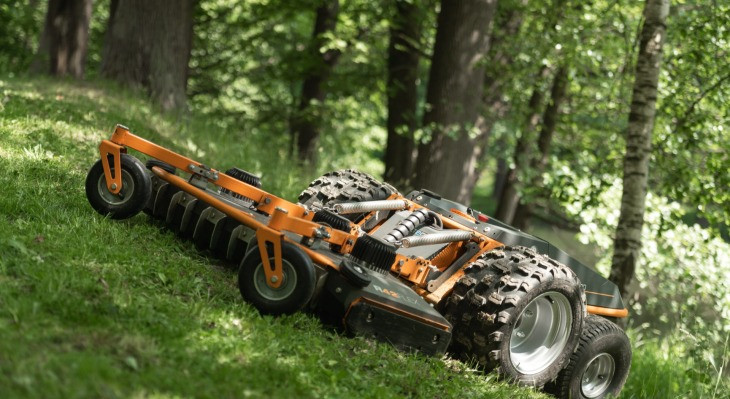
Professional steep slope mowers are purpose-built from the ground up for extreme terrain. Their defining characteristics include a low center of gravity, optimized weight distribution, all-wheel drive, and a robust frame construction. One example of such a platform is Raymo, a fully electric machine developed specifically for steep slopes. Thanks to its low profile (approx. 51 cm), 4×4 drivetrain, and carefully engineered chassis, it can operate safely on slopes exceeding 45°. This is not a marketing claim—stability is a core design principle.
On steep slopes, it’s not only the machine’s stability that matters—it’s also the safety of the person operating it. With conventional equipment, the operator sits directly on the slope and is exposed to rollover risk. With remote-controlled steep slope mowers, the operator remains outside the risk zone while maintaining full control over the machine. This approach significantly elevates safety standards. The operator can react immediately, maintain better situational awareness, and avoid unnecessary physical strain and direct exposure to hazards.
Steep slopes are not rare—they are a common part of modern infrastructure. You encounter them along highway and railway embankments, on dam walls and retention basins, in industrial sites, and in solar parks built in complex terrain. In these environments, the right combination of stability, low ground pressure, and the ability to work reliably over long periods is essential.
Electric drivetrains deliver key benefits on steep terrain. Instant torque enables precise power control and smooth response to changing conditions. Reduced vibration supports stability and improves handling. In addition, zero emissions, low noise, and lower operating costs make electric steep slope mowers well suited for urban areas and environmentally sensitive locations.
On large-scale slope maintenance jobs, continuity matters. The ability to quickly swap battery modules allows near-continuous operation without long charging breaks. This increases productivity and helps reduce total vegetation-management costs.
A steep slope is not the place for a conventional mower. It demands a purpose-built machine focused on stability, safety, and long-term reliability. Steep slope mowers are now an essential tool for professional vegetation management—and that’s where the difference between a universal solution and a truly specialized slope platform becomes clear, ready to work where other machines must stop.
Book a free on-site demonstration and see how the mower performs on your steep terrain.